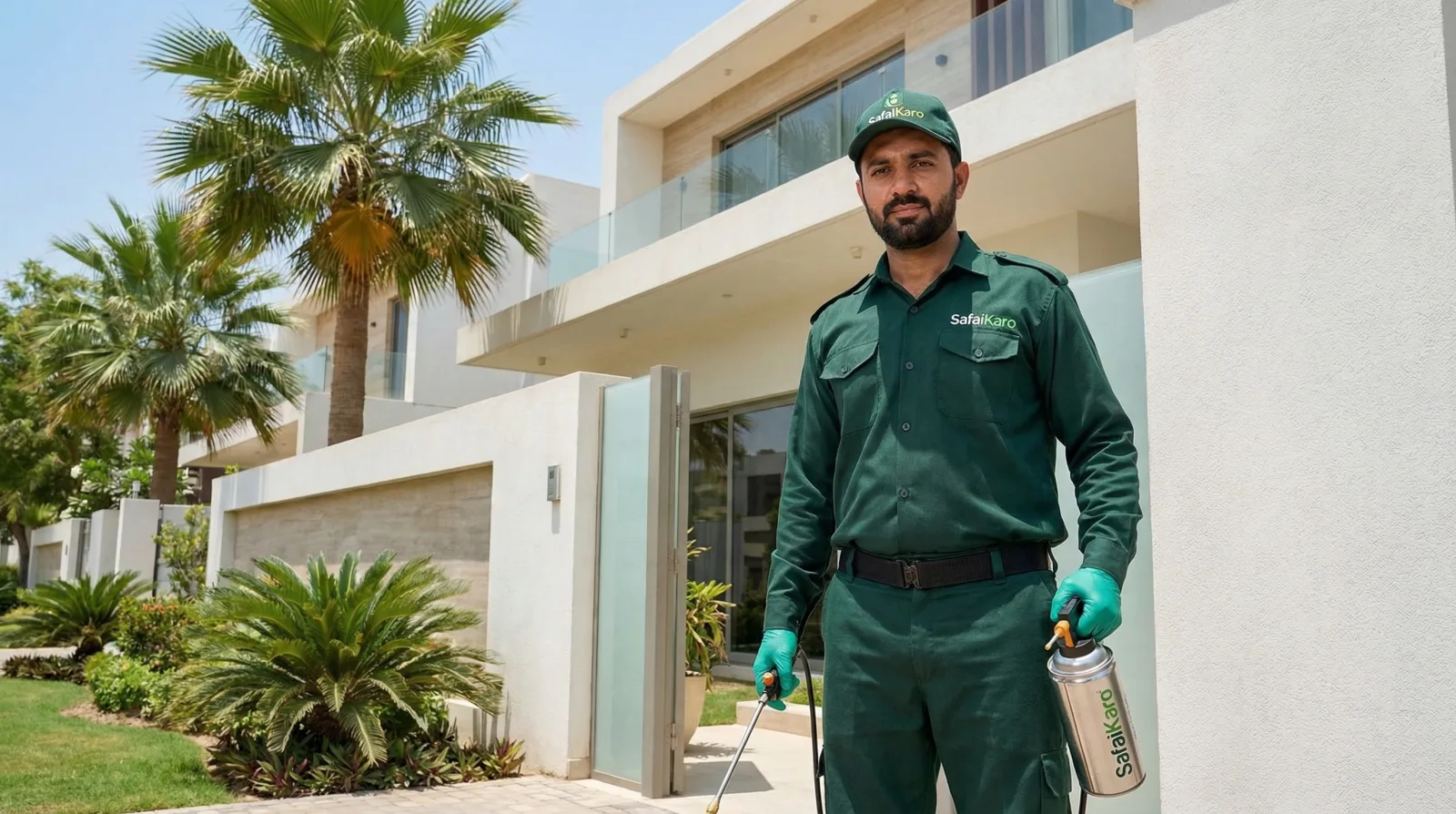
Blocks 1 to 5, Rizvia Society, Liaquatabad & FC Area — same-day available, prices online, 90-day guarantee.
Nazimabad is Karachi's original 1952 refugee-resettlement scheme — the Greater Karachi Resettlement Plan, built to house Partition-era Muhajir refugees. It runs from the original Block 1 to Block 5, through Rizvia Society, and borders Liaquatabad, one of the most densely populated districts in the city, sitting directly on the flood-prone Gujjar Nala.
That combination of age and density defines the area's pest profile. Original single-story homes built by settlers themselves in the mid-1950s mean seven decades of timber roofing and window frames — comparable termite exposure to DHA Phase 1's oldest bungalows. Liaquatabad's roughly 91,000 people per sq km (per 2023 census figures) means any infestation spreads to neighbouring units far faster than in low-density housing, and its position on the Gujjar Nala brings documented, repeated flooding — 2009 and 2020 among the recorded events — that leaves standing water for days.
Every price is published upfront before you book. Fumigation starts from Rs 7,000, termite proofing from Rs 13,000, and our Annual Shield plan covers 4 visits a year plus 1 emergency callout between visits. Technicians are dispatched daily across Karachi from our DHA Phase 8 base, with same-day appointments often available if you contact us before 10am.
In Nazimabad and Liaquatabad's 70-year-old housing stock, most first calls are about termites in original roof timber — but the booking that follows the inspection is usually general fumigation for cockroaches, ants and crawling insects, priced by property size from Rs 7,000. See the dedicated fumigation services in Karachi page for the full size-based price breakdown, process and safety details, or check the complete price list for every service we offer here.
Nazimabad was developed from 1952 under the Greater Karachi Resettlement Plan to house Partition-era Muhajir refugees. Original single-story homes in Blocks 1 to 3 were built by settlers themselves in the mid-1950s, meaning seven decades of timber roofing and window frames — comparable termite exposure to DHA Phase 1's oldest bungalows, where the same aging-timber pattern drives high termite risk.
These blocks were designed around internal, self-sufficient market sections. Older shared drainage and market infrastructure near the block cores concentrates cockroach and rodent pressure that spreads to adjoining homes — a home near a Block 1–3 internal market faces meaningfully more pest pressure than one on a quieter residential street further from the market core.
Our approach for Block 1–3 starts with a structural assessment of roof beams and window frames before any chemical is applied, since seven-decade-old timber is the primary termite entry point. For confirmed activity we use a soil injection plus bait station combination with a three-year structural guarantee. For homes near the internal market sections, we add drainage cover treatment and perimeter gel baiting to address the shared-infrastructure cockroach and rodent pressure.
Termite treatment for a Block 1–3 home starts from Rs 13,000 for properties up to 100 sq yards. General fumigation starts from Rs 7,000. Book a structural inspection before any renovation disturbs original timber framing.
Block IV holds Nazimabad's largest plots, at 240+ sq yards, with more mature gardens than the rest of the neighbourhood. Larger, older gardens and boundary plantings offer greater termite and ant harborage than the smaller commercial blocks VI–VII — garden timber and root systems give termites a stepping stone from soil into the main structure, the same dynamic documented in DHA Phase 6's villa belt, just at a smaller scale.
Blocks IV and V also sit closest to the commercial sections (VI–VII), so shared drainage with ground-floor shops adds cockroach pressure on top of the standard garden-termite risk. A Block 4–5 home near the commercial boundary effectively faces two separate pest challenges at once, rather than the single garden-driven risk that would apply further from the shops.
For Block 4–5 properties we cover the full garden perimeter for termite risk — not just the house structure — including boundary plantings and garden timber, plus drainage cover treatment and gel baiting for homes closest to the commercial sections.
For Block IV's typical 240+ sq yard plots, full-perimeter termite treatment falls in the Rs 20,000 (201–300 sq yards) tier, confirmed against your actual plot size before we start. General fumigation starts from Rs 7,000.
Rizvia Society is a residential society within Nazimabad, predominantly built up with older single-family homes constructed in the same era as the core Nazimabad blocks. That shared construction vintage means Rizvia Society carries the same aging-construction termite risk profile as the rest of Nazimabad — original timber framing that has had decades to develop the cracks and cavities termites exploit.
Because Rizvia Society sits within the broader Nazimabad scheme, the same drivers apply here as in the numbered blocks: unaddressed structural aging is the primary pest risk, more than any factor unique to the society itself.
Our protocol for Rizvia Society mirrors what we use across Nazimabad's older blocks — a structural assessment first, followed by soil injection and bait station treatment for confirmed termite activity, backed by a three-year structural guarantee.
Termite treatment in Rizvia Society starts from Rs 13,000 for homes up to 100 sq yards. General fumigation starts from Rs 7,000. Book a structural assessment to get a property-specific quote.
Liaquatabad is one of Karachi's most densely populated districts — 2023 census figures put Liaquatabad Town at roughly 91,000 people per sq km, well above the Karachi Central District average. That density means any infestation spreads to neighbouring units far faster than in low-density housing, so a treatment that only addresses one unit tends to see reinfestation from the crowded units around it.
Liaquatabad sits directly along the Gujjar Nala, which has repeatedly overflowed into its homes and shops during monsoon — documented in 2009 and 2020, with water reported entering houses "like a flash flood." Standing water breeds mosquitoes for days and dampens ground floors, which in turn accelerates both termite and cockroach activity in the affected blocks. Dense wholesale and retail markets for furniture, clothing, shoes and jewellery in Liaquatabad also concentrate stored goods and cardboard packaging next to residential blocks above and behind the shops — classic cockroach and rodent harborage.
Our approach in Liaquatabad combines outdoor larvicide applied to standing water as part of every fumigation visit — not as an add-on — with drainage cover treatment and perimeter gel baiting for homes near the wholesale markets, since shared storage and packaging areas keep re-seeding cockroach and rodent populations regardless of how well one unit is treated.
General fumigation with larvicide included starts from Rs 7,000 for homes up to 100 sq yards. For homes and shops in flood-affected blocks, our Annual Shield plan — 4 visits a year plus 1 emergency callout — from Rs 18,000/year keeps mosquito and rodent pressure under control through each monsoon rather than only after standing water has already appeared.
Repeated anti-encroachment demolition along the Gujjar Nala — 600+ structures surveyed in 2020, with hundreds more cleared by 2022, including sections at Hasan Colony and the FC Area — has displaced rodent colonies into adjacent residential blocks, similar to the renovation-driven rodent spikes documented in DHA Phase 4. When burrow networks near the nala are broken up by demolition, the rats that occupied them move into the nearest standing structures, which are the homes bordering the cleared sections.
Dense, closely built housing in Liaquatabad No. 10 shares the same lateral-spread pest dynamic as the rest of Liaquatabad Town, with limited setback between homes. Tight spacing between properties here means pests move between adjoining homes faster than they would on larger, more separated plots.
For FC Area properties near recently cleared or demolished sections, we recommend a rodent survey and entry-point sealing rather than bait placement alone, since displaced colonies actively seek new harborage rather than simply dispersing. For Liaquatabad No. 10's tightly packed housing, we pay particular attention to shared boundary walls during inspection, the same approach we use in other closely-spaced Karachi neighbourhoods.
Rodent control in FC Area and Liaquatabad No. 10 starts from Rs 13,000 for homes up to 100 sq yards. Combine it with general fumigation from Rs 7,000 for full coverage, especially if your property borders a recently cleared section of the nala.
Same prices across Nazimabad and Liaquatabad. No hidden charges, ever.
| Fumigation | Termite | Bed Bugs | Rodent | Annual Shield | |
|---|---|---|---|---|---|
| Up to 100 sq yds | Rs 7,000 | Rs 13,000 | Rs 11,000 | Rs 13,000 | Rs 18,000/yr |
| 101–200 sq yds | Rs 11,000 | Rs 17,000 | Rs 14,000 | Rs 16,000 | Rs 24,000/yr |
| 201–300 sq yds | Rs 13,000 | Rs 20,000 | Rs 17,000 | Rs 18,000 | Rs 40,000/yr |
| 301–500 sq yds | Rs 16,000 | Rs 27,000 | Rs 23,000 | Rs 21,000 | Rs 40,000/yr |
| 501–1,000 sq yds | Rs 20,000 | Rs 37,000 | Rs 29,000 | Rs 29,000 | Rs 65,000/yr |
Price confirmed before we start. Zero hidden charges. Balance paid to technician on the day.
Seven-decade-old timber roof beams and window frames from the original 1950s construction are the main entry point for termites in Nazimabad. We recommend a structural assessment before any chemical treatment, followed by a soil injection plus bait station combination with a three-year structural guarantee for confirmed activity.
We cover Nazimabad Blocks 1 through 5, Rizvia Society, Liaquatabad including Liaquatabad No. 10, and the FC Area.
Yes — larvicide is applied to standing water points as part of every fumigation visit in Gujjar Nala-adjacent blocks, not as an add-on. This directly addresses the documented flood-related standing water that recurs in Liaquatabad during monsoon.
Termite treatment in Nazimabad starts from Rs 13,000 for homes up to 100 sq yards, scaling with property size up to Rs 37,000 for 501–1,000 sq yards.
Yes, for both residential and commercial units in Liaquatabad, subject to booking before 10am and technician availability.
Same-day service available across Nazimabad and Liaquatabad. Prices confirmed before we start. 90-day guarantee on every job.