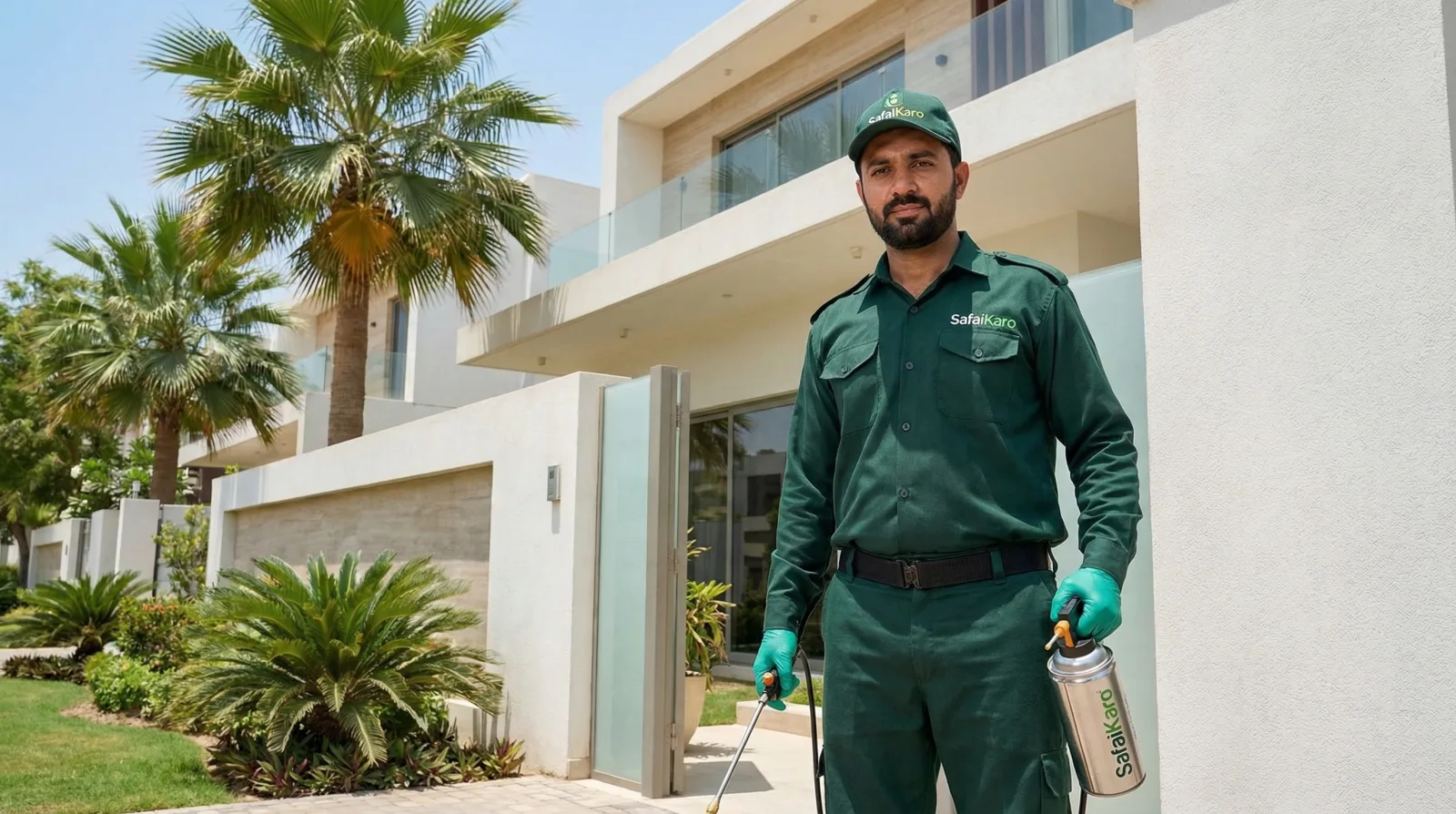
Sectors 5, 7, 11-C, 11-J and Khawaja Ajmer Nagri — same-day available, prices online, 90-day guarantee. Certified technicians dispatched daily from our DHA Phase 8 base.
North Karachi was developed in the 1950s and 60s as a satellite resettlement town — originally called New Karachi — built to decongest central Karachi after Partition-era refugee resettlement. That means Sectors 5 through 11-C carry decades of housing stock, dense low-rise residential grids, and a location between the Manghopir Hills and the Lyari River corridor that shapes the pest pressure the area sees today.
The area's age and its position near the Gujjar Nala — which originates in Sector 11-J — are the two biggest drivers of pest activity here. Older sectors carry the same aging-construction termite exposure documented across Karachi's original 1950s neighbourhoods, while proximity to the nullah network creates recurring standing-water and mosquito-breeding risk in sectors closest to the drain. Tight lanes and narrow row-house spacing in Sector 5 and Sector 11-C also let infestations move laterally between adjoining homes faster than on larger plots.
Every price is published upfront before you book. Fumigation starts from Rs 7,000, termite proofing from Rs 13,000, and our Annual Shield plan covers 4 visits a year plus 1 emergency callout between visits, from Rs 18,000/year. Same-day appointments are often available if you contact us before 10am, subject to technician availability.
In North Karachi's older sectors the recurring problem is rodents around Khawaja Ajmer Nagri's markets and standing water in the 11-J nullah corridor. The workhorse visit is still general fumigation: a single-visit treatment for cockroaches, ants, and crawling insects, priced by property size from Rs 7,000. See the dedicated fumigation services in Karachi page for the full size-based price breakdown, process, and safety details, or check the complete price list for every service we offer in North Karachi.
North Karachi's core sectors — Sector 7 through Sector 12 — were developed in the 1950s and 60s as part of the original New Karachi resettlement town, built to decongest central Karachi after Partition-era refugee resettlement. Homes in these older sectors carry the same aging-construction profile documented in Nazimabad's earliest blocks: decades-old roofing timber, original window frames, and masonry that has had six decades to develop the cracks and cavities that let termites in.
The area's location between the Manghopir Hills and the Lyari River corridor adds a second layer of pressure. The Gujjar Nala — the storm drain that repeatedly floods Liaquatabad, Gulberg and North Nazimabad further downstream — originates within North Karachi's Sector 11-J, so the whole Sectors 7–12 corridor sits inside the same nullah network and faces recurring standing-water exposure during monsoon, on top of its termite risk.
Our approach in the older Sectors 7–12 blocks starts with a structural assessment of roof beams, window frames, and skirting boards before any chemical is applied. For confirmed termite infestations we use a soil injection and bait station combination, which is more effective than surface spray alone in aging-construction homes, backed by a 3-year structural guarantee. Fumigation visits in flood-affected sections of the corridor include larvicide on standing water and residual spray on outdoor walls as standard, not as an add-on.
General fumigation for a standard North Karachi home up to 100 sq yards is Rs 7,000, and termite treatment starts from Rs 13,000. Book an inspection before the next monsoon if your home is in a low-lying section of Sectors 7–12.
Sector 11-J holds a specific distinction in Karachi's drainage geography: the Gujjar Nala, the storm drain that repeatedly overflows into Liaquatabad, Gulberg Town and North Nazimabad downstream, originates here. That means homes closest to the drain head in Sector 11-J face the earliest and most direct standing-water exposure of any sector we cover in North Karachi — not a secondary or downstream effect, but the source of it.
Encroachment along the upper stretch of the drain has narrowed the channel in places, the same root cause documented for flooding further downstream in Liaquatabad and Gulberg. For Sector 11-J residents this means monsoon rain collects and holds longer near the nullah than in sectors set back from it, which is a direct mosquito-breeding trigger and, over repeated seasons, a source of damp-foundation termite risk as soil moisture rises against slabs.
Our fumigation visits in Sector 11-J apply WHO-approved larvicide to standing water points on and near your property as a standard part of the service, plus residual insecticide on shaded exterior wall surfaces where adult mosquitoes rest during the day. For homes showing foundation dampness from repeated nullah overflow, we recommend pairing a fumigation visit with a termite inspection rather than waiting for visible activity.
Fumigation with larvicide included starts from Rs 7,000 for homes up to 100 sq yards. Given the ongoing, source-of-drain exposure in Sector 11-J, the Annual Shield plan — four visits a year plus one emergency callout between visits, from Rs 18,000/year — is worth considering over a one-off treatment.
Sector 5 and Sector 11-C are built out as dense, low-rise residential grids with narrow lanes and shared boundary walls — a tighter layout than the larger detached plots found in DHA or Clifton. That row-house spacing is the defining feature of pest pressure in these two sectors: infestations do not stay contained to one property the way they might on a larger, more isolated plot.
Because homes in Sector 5 and Sector 11-C share boundary walls and, in many rows, common drainage runs, cockroach and ant activity moves laterally between adjoining homes considerably faster than in low-density housing. A single-property treatment that ignores this reality tends to see reinfestation quickly, since the source colony next door was never addressed.
Our treatment for Sector 5 and Sector 11-C accounts for this row-house dynamic directly — perimeter gel baiting at shared boundary walls and drainage entry points, rather than interior-only spraying, is standard on every visit. Where multiple adjoining households in the same row are dealing with the same infestation, we can coordinate visit timing so neighbouring homes are treated close together and the reinfestation loop is broken.
General fumigation for a typical Sector 5 or Sector 11-C home up to 100 sq yards is Rs 7,000. Talk to your neighbours before booking if the infestation is affecting more than one home on your row — treating in sequence is far more effective than treating alone.
Khawaja Ajmer Nagri is a dense residential pocket within North Karachi, built along narrow streets with closely spaced housing. Like Sector 5 and Sector 11-C, the tight layout means less physical separation between properties than in Karachi's newer, larger-plot neighbourhoods — and that shapes where pest pressure concentrates.
The area's concentrated waste collection points, sitting close to residential lanes because of the tight street layout, are a steady rodent food source that feeds directly into surrounding homes. Rats moving between waste points and nearby properties are the most common call-out we see from this locality, more than termite or cockroach issues on their own.
Our rodent programme for Khawaja Ajmer Nagri prioritises entry-point sealing at utility ducts and drain covers alongside tamper-resistant bait station placement — blocking the route rats use to reach your kitchen is more durable than bait alone in an area with a constant nearby food source. For general fumigation, the same crack-and-crevice and perimeter treatment used across North Karachi's denser sectors applies here too.
Rodent control starts from Rs 13,000 for homes up to 100 sq yards, and general fumigation from Rs 7,000. Book a same-day inspection if you're seeing rodent activity near a waste collection point on your street.
Same prices across all North Karachi sectors and Khawaja Ajmer Nagri. No hidden charges, ever.
| Fumigation | Termite | Bed Bugs | Rodent | Annual Shield | |
|---|---|---|---|---|---|
| Up to 100 sq yds | Rs 7,000 | Rs 13,000 | Rs 11,000 | Rs 13,000 | Rs 18,000/yr |
| 101–200 sq yds | Rs 11,000 | Rs 17,000 | Rs 14,000 | Rs 16,000 | Rs 24,000/yr |
| 201–300 sq yds | Rs 13,000 | Rs 20,000 | Rs 17,000 | Rs 18,000 | Rs 40,000/yr |
| 301–500 sq yds | Rs 16,000 | Rs 27,000 | Rs 23,000 | Rs 21,000 | Rs 40,000/yr |
| 501–1,000 sq yds | Rs 20,000 | Rs 37,000 | Rs 29,000 | Rs 29,000 | Rs 65,000/yr |
Price confirmed before we start. Zero hidden charges. Balance paid to technician on the day.
SafaiKaro covers North Karachi Sectors 5 and 7 through 12 (including 11-C and 11-J) plus Khawaja Ajmer Nagri. Technicians are dispatched daily across Karachi from our DHA Phase 8 base, and same-day service is available if you book before 10am, subject to technician availability.
Yes — larvicide on standing water plus residual spray on outdoor walls is applied as part of every fumigation visit in sectors affected by Gujjar Nala overflow, including Sector 11-J where the drain originates.
General fumigation starts from Rs 7,000 for homes up to 100 sq yards, and Rs 11,000 for 101–200 sq yards — the same published pricing used across Karachi. Prices are confirmed before we start, with zero hidden charges.
Yes. We start with a structural assessment of roof beams, window frames and skirting boards, then apply a soil injection and bait station combination for confirmed infestations, backed by a 3-year structural guarantee — the same protocol used for other 1950s-60s Karachi housing stock. Termite treatment starts from Rs 13,000.
Yes, if contacted before 10am, subject to technician availability. Our technicians are dispatched daily across North Karachi from our DHA Phase 8 office.
Same-day service available across all North Karachi sectors and Khawaja Ajmer Nagri. Prices confirmed before we start. 90-day guarantee on every job.